
What a Real Birth Team Looks Like

And why the “doulas vs. nurses” framing hurts families, and where the actual problem lives.
May 2026 · Lorie Michaels, CD(DONA), LCCE, CLC, PMH-C
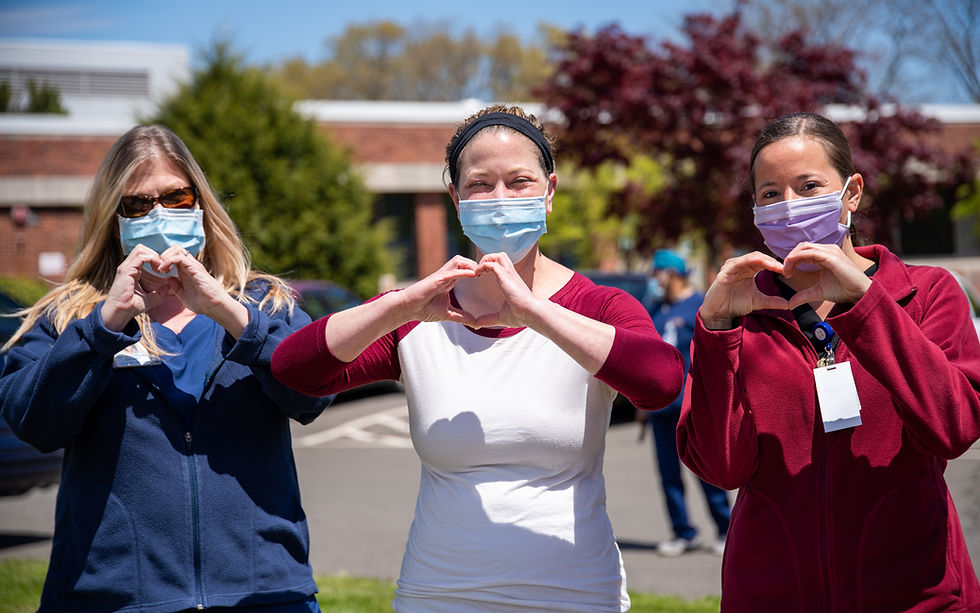
Let me say this plainly: Doulas are not in competition with hospital staff.
I have worked alongside L&D nurses for years. I have watched them love families through terrifying moments, advocate quietly in ways that never made it into the chart, and hold space for people in the hardest hours of their lives. The vast majority of nurses I have worked with are talented, compassionate, highly educated and deeply committed to the families in their care.
And they are exhausted. Overextended. Asked to do more than any one person can do well, in less time than the work deserves, inside a system that too often measures success in room turnover rather than outcomes.
That is not a nurse problem. That is a system problem. And when doulas treat nurses as the obstacle, we are aiming at the wrong target.
The “Us Against Them” Story Serves the System, Not Families
There is a version of doula culture that positions us as the family's protector against a hostile medical system. Nurses are obstacles. OBs are adversaries. The doula swoops in to save the birth.
This framing is not only inaccurate. It is actively harmful.
When a doula walks into a hospital room with an adversarial posture, the person who pays for it is the family. Nurses become guarded. Providers become defensive. The collaborative relationship that actually leads to better outcomes gets replaced by tension, and the family is stuck in the middle of a dynamic they never asked for.
The us-against-them narrative also lets the actual problem off the hook. The problem is not the nurse at the bedside. The problem is that the nurse at the bedside has four other families on the floor, a mandatory charting load that could occupy a full-time position on its own, and administrators measuring her performance by metrics that have nothing to do with whether a family felt supported.
We know that it rolls downhill. The pressure that comes from profit-driven healthcare organizations lands on nurses, midwives, and OBs, who are sometimes forced to offer choices they do not personally believe in, and to move faster than good care allows. They are not the source of that pressure. They are living inside it, just like families are.
When doulas treat nurses as the obstacle, we are aiming at the wrong target.
What Each Person Actually Brings
A doula and a nurse are not doing the same job. They are doing complementary jobs, and the distinction matters.
The nurse has clinical training, medical knowledge, and accountability for monitoring, intervention, and safety. She is responsible for the medical picture. She is also responsible for other families on that floor simultaneously. Her presence is essential and her skills are irreplaceable.
The doula has continuous, undivided presence. No charting, no other rooms, no monitor to check. The doula is there for one family, for the whole of the experience, including the emotional and relational dimensions that clinical care does not have the structure to hold.
Those roles are not in competition. They are a natural partnership. When both are functioning well, families have someone managing the medical landscape and someone managing the human one. That is a dream team.
The reason that dream team is not the norm has nothing to do with incompatibility between the roles. It has to do with a healthcare environment that has made nurses too stretched to build relationships with the doulas in their unit, and a doula culture that has sometimes made nurses feel judged rather than supported.
What Doulas Are Actually There For
Doulas are there to support healthy, empowered birth. Not to disrupt the process. Not to insert ourselves between families and their medical care. Not to perform heroics.
We are there to help families understand what is happening, ask questions, know their options, and feel supported through whatever the birth brings. Sometimes that means comfort measures and encouragement. Sometimes it means sitting quietly while a nurse does her job and being present when the nurse has to leave the room.
We are not anti-intervention. We are pro-information. There are real medical reasons for inductions, cesareans, and epidurals. A good doula does not work against those decisions. A good doula helps families understand them, participate in them, and feel like agents in their own birth rather than passengers.
Holding the line on advocacy does not mean being adversarial. It means being consistent about centering the family's voice, their informed choices, and their right to be treated with dignity, regardless of what path their birth takes.
What Building a Real Birth Team Looks Like
In practice, a collaborative birth team starts before anyone walks into a hospital room. It starts in prenatal visits when doulas help families clarify what they want, how they want to communicate it, and what support they are hoping for from their care team.
It continues in the first moments of a labor room visit, when a doula introduces herself, learns the nurse's name, and makes clear that she is there to work with the team, not around it.
WHAT THAT ACTUALLY SOUNDS LIKE
"Hi, I'm Lorie, I'm their doula. It's great to meet you. What do you need from me to make this work well for everyone?"
"I'll stay out of your way when you need to work. Just let me know."
"Can you help me understand what you're seeing on the monitor so I can help them track what's happening?"
"They have some questions about this recommendation. Would you have a few minutes to walk them through it?"
That is not passivity. That is strategy. A doula who builds rapport with the nurse is a doula who has a real ally in the room. And families benefit from that alliance in ways that adversarial positioning never produces.
To the Nurses Reading This
We see you. We see the staffing ratios that are not sustainable. We see the charting burden that follows you home in your head. We see you trying to give every family more than the system is currently set up to let you give.
A well-trained doula is not there to second-guess you. We are not there to document against you or police your practice. We are there because continuous support during labor produces better outcomes, and you cannot be in one room continuously while you have a whole floor.
The best births I have been part of happened when the nurse and I were working together, reading the room together, and keeping the family at the center of everything. I want more of those births. I think you do too.
They hired the nurse. They hired the doula. They hired the OB or midwife.
They built a team. Our job is to function like one.
BirthPro trains birth workers who understand the difference between the system and the people inside it. If that's the kind of practice you want to build, we'd love to have you.


